 Voted among the "Top International Surgeons".
Elected to "Top 5% of United States Surgeons". Voted among the "Best Doctors" in Mid TN by the Nashville Business Journal.
Voted among the "Top International Surgeons".
Elected to "Top 5% of United States Surgeons". Voted among the "Best Doctors" in Mid TN by the Nashville Business Journal.Laparoscopic Excision of Endometriosis
 Endometriosis is a condition that causes pelvic pain, painful periods, and infertility. Endometriosis is caused by the cells of the inside of the uterus migrating to a different location. The cells on the inside of the uterus, called endometrial cells, are normally built up and shed as a period each month. In some women these cells are misplaced on the inside lining of the abdomen. Since this is not their usual location, the body sees these as “foreign” cells; a reaction much like an infection then occurs with inflammation and scarring. This reaction is what causes the pain with endometriosis. Pain of endometriosis often worsens gradually because the misplaced endometrial cells bleed each month at the same time as a period. The cyclic bleeding causes more inflammation each month, which gradually leads to more scarring and pain.
There are two broad categories of management of endometriosis: treatment and cure.
Excisional Endometriosis
The treatment of endometriosis is by either medicine or surgery. Medicine treatment of endometriosis is done by either birth control pills, progesterone, or Lupron. Birth control pills and progesterone treat the endometriosis by decreasing the amount of bleeding each month. This decreases the stimulation of the existing endometriosis and also decreases the amount of new endometriosis that forms.
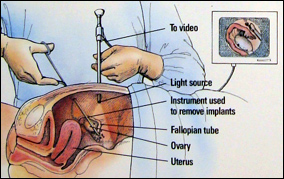
Surgical treatment of endometriosis involves laparoscopic complete excision of endometriosis. Laparoscopic surgery is done using a camera placed through a one quarter inch incision in the belly button. Two or three other incisions also one quarter inch in diameter are placed in various areas in the abdomen for surgical instruments. Laparoscopic treatment of endometriosis completely removes all visible spots of endometriosis and scar tissue. Laparoscopic complete excision of endometriosis is the best way to treat the pain of endometriosis. This is because all spots of endometriosis are removed, therefore the body no longer needs to respond using inflammation and scarring. The scar tissue that is present as a result of the existing endometriosis is also removed at the time of surgery. The complete excision of scar tissue markedly decreases the pain that is present all throughout the month, at ovulation, and with intercourse.
Dr. Maikis specializes in the complete resection of all endometriosis. She is able to remove endometriosis even if it involves the major organs of the pelvis. With complete resection, the time interval between laparoscopic surgeries is longer, and pain relief is better.
Cure for Endometriosis
The cure for endometriosis is the removal of the uterus along with the complete resection of all visible endometriosis in the body. Since the uterus is the source of endometriosis, if it is removed, there is no need for surgical menopause. It is not necessary to remove the ovaries for complete treatment of endometriosis. When the ovaries are left in place, the body can go into menopause naturally. There is complete pain relief without the side effects of menopause.
Endometriosis and Infertility
Endometriosis decreases fertility. The probable way that it decreases fertility is by creating an environment inside the pelvis that is toxic to eggs. An egg is released from the ovary at ovulation, and needs to be picked up by the fallopian tube. Before it goes into the fallopian tube, it is exposed to the environment inside the pelvis. The body’s response to endometriosis is to bring its inflammation cell to try to heal the endometriosis from within. This inflammatory environment is toxic to eggs. Laparoscopic complete excision of endometriosis removes endometriosis. The body then does not have to create inflammatory cells to heal the endometriosis on its own.
Endometriosis causes infertility by causing scar tissue in the pelvis. This scar tissue can move the ovaries and fallopian tubes away from each other, can block the eggs from releasing from the ovary, and can block the fallopian tube from picking up the egg after ovulation. Removing scar tissue at laparoscopic surgery can improve all of these mechanical blockages caused by endometriosis.
New evidence from scientific studies in infertility show that earlier surgical diagnosis and complete excision of endometriosis preserves future fertility. We used to believe that the infertility associated with endometriosis was in part due to the scarring after surgery. Now we know that the endometriosis itself is responsible for so much of the inflammation and scar tissue, that the earlier endometriosis is removed, the less inflammation is present. Recommendations used to include delaying surgical excision for endometriosis for as long as possible to minimize the surgical scarring. Now we know that surgery contributes to little, if any, scar tissue, and that continued growth of endometriosis is responsible for the vast majority of the damage that leads to infertility. So if you have endometriosis, or the symptoms of endometriosis, and desire future fertility, it is strongly recommended not to delay surgical diagnosis and treatment.